
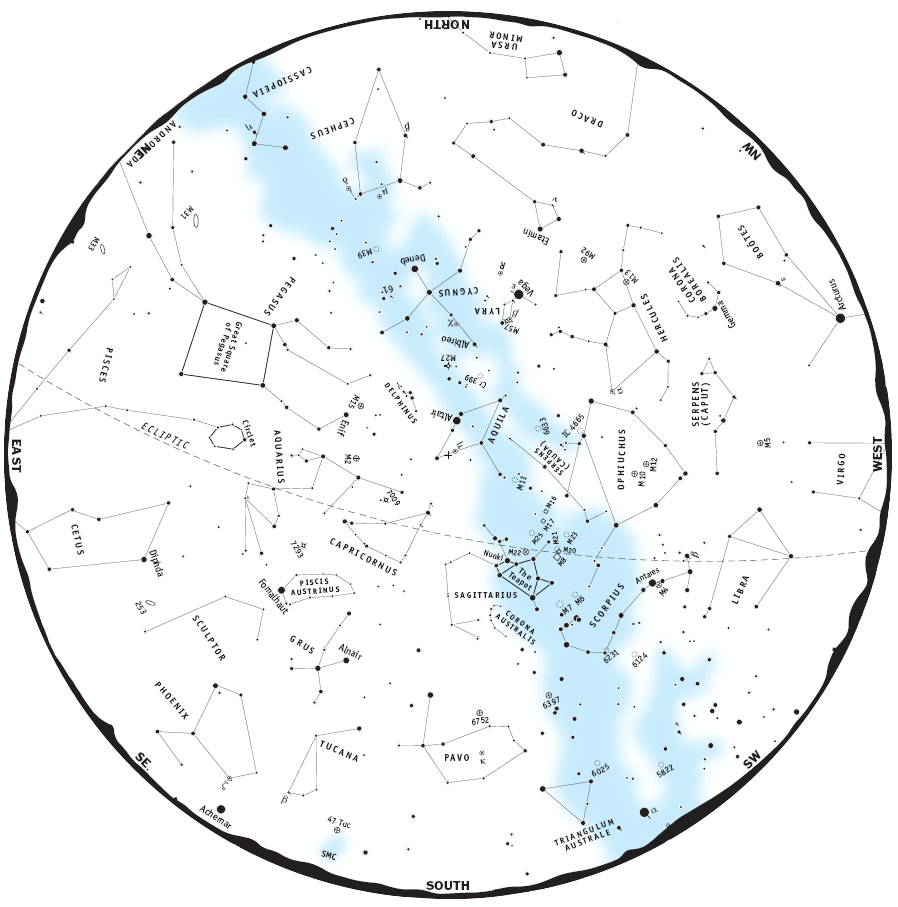
Even though the summer monsoon brings plenty of humidity, Maldivian nights in these months are usually clear or, at most, veiled by fast-moving clouds. The sky map shows the sky in August at about 11 pm local time.
Once our eyes have adjusted to the dark, we are astonished by the magnificent glowing band crossing the whole sky. It looks like clouds reflecting the lights of distant islands. In fact, we are seeing the light of billions of tiny stars in our Milky Way, too far away to be seen individually.
Unlike the winter Milky Way, the summer view of our Galaxy is broken up into dark and bright patches, especially toward the south. We can clearly see that the band is wider here: this region contains the core of the Galaxy. Our eyes are looking toward the center around which all the stars we see revolve, where a supermassive black hole of about four million solar masses, Sagittarius A*, lies hidden. Its existence earned a Nobel Prize in 2020, and in 2022 it was photographed for the first time.
Our Sun, too, takes part in this procession: it needs about 250 million years to complete one lap. It is strange to think that one “galactic year” ago there were no humans on Earth, and not even dinosaurs: our planet was just recovering from the greatest mass extinction in its history.
First of all, hold the map above your head and orient it so that it matches the sky. To do this, find the cardinal points. The Sun sets in the west, so if you face that direction, north is on your right, south on your left and east behind you.
As time goes by, you will notice that the stars… move! They slowly travel from east to west, just like the Sun. So our sky map is only valid for a limited part of the night. To see what the sky will look like at any other time, you need planetarium software, such as the excellent Stellarium.
Many mobile apps can show you the sky according to where you point your phone: a very useful teaching tool.
We all know that the easiest way to find the North Star is to start from the Big Dipper, which we were taught is always visible. To our disappointment, when we look north we see no Bear at all! Near the equator every constellation rises and sets, and in this season the Big Dipper is below the horizon at night.
What can we do?
We have to look for another constellation, on the opposite side of the North Star from the Big Dipper: Cassiopeia. It is a W-shaped group of five stars that opens right toward the North Star, which lies just above the horizon. The North Star is not particularly bright: contrary to popular belief, it is not the brightest star in the sky.
Cassiopeia lies within the Milky Way. If we follow that glowing band upward, we reach a fairly large, cross-shaped constellation: Cygnus, the Swan, also known as “the Northern Cross”.
The constellation depicts a bird with outstretched wings, its beak pointing toward the center of the Galaxy. The Swan’s tail is marked by the bright star Deneb, a white supergiant about 200,000 times more luminous than our Sun.
If we could bring it to the distance of Sirius, it would light up our nights more than a half Moon!
The Swan’s beak is famous for the prettiest double star in the whole sky: Albireo. Even a small telescope shows a lovely pair of stars, one blue and the other orange: a beautiful color contrast.

Near the Swan shines the bluish star Vega, the main star of Lyra.
Toward the south, almost as bright as Vega, we can see Altair, the main star of Aquila, the Eagle. This completes the Summer Triangle, the key to the summer sky, just as Orion is the key to the winter sky.


The Eagle, too, depicts a bird with outstretched wings and its beak pointing toward the center of the Galaxy.
Continuing along the Milky Way, we find two beautiful constellations: one looks just like its name, the other… not at all! Scorpius, the Scorpion, is clearly outlined by bright stars marking the claws (three stars in a row), the body (the bright red star Antares), the long tail and the sting (two stars very close together).
Sagittarius, the Archer, takes a lot of imagination to see as a centaur drawing his bow. It is better to follow the British, who call it “the Teapot”. And they are right: you can see the lid, the handle and the spout!

Sweeping these constellations with binoculars is a delight. Even without knowing what we are looking at, we will see star clusters, nebulae, double stars, dark clouds and colorful stars. A feast for the eyes.
Following the Milky Way down toward the horizon, if we are lucky we will see Alpha and Beta Centauri. The former, clearly yellowish, is the nearest star system to us.
Let’s go back to the Summer Triangle. If we draw a line from Deneb through Vega and keep going, we reach the fourth brightest star in the sky: Arcturus. It is the main star of Boötes, the “guardian of the Bear”. This orange star is getting closer to us: in about 4,000 years it will reach its minimum distance, and then move away again, back into the depths of the Galaxy.
Before reaching Arcturus, we pass a graceful semicircular constellation: Corona Borealis, the Northern Crown.
On the opposite side of the sky, toward the east, the autumn constellations are rising. The great Square of Pegasus and Andromeda is clearly visible.
The constellation of Andromeda hosts the most famous galaxy visible to the naked eye, together with the Magellanic Clouds: the Andromeda Galaxy. To find it, follow the map, but also remember the first rule of stargazing: averted vision.
Our eyes are designed for daytime color vision: the central part of the retina is rich in cells sensitive to bright, colored light (the cones). The cells that work at night (the rods) are more numerous in the outer part of the retina. So, to see a faint object in the night sky, look a few degrees to one side of it. Like magic, you will see it more clearly than by looking straight at it!
To the right of Pegasus are the constellations of Aquarius, which is rather faint, and Capricornus, the Sea Goat. The latter has few bright stars, but its triangular shape is well outlined by many faint ones.
Planets move from year to year, so check with Stellarium which ones are visible during your stay. If it is Jupiter, the king of the planets, even binoculars will show its oval disk and its four large moons lined up along its equator: Io, Europa, Ganymede and Callisto. Hour after hour, you can clearly see them orbiting the planet in a kind of… celestial dance!
Below the Sea Goat lies a less interesting part of the sky: it is far from the Milky Way and therefore poor in stars. Here we find four large birds: the Crane, the Toucan, the Peacock and the Phoenix.
A special mention goes to the Southern Fish, just below Aquarius and the Sea Goat. Its main star, Fomalhaut, is a bright and solitary star surrounded by belts of dust, like a planetary system still in the making. The Hubble Space Telescope seemed to have photographed a planet there, but it turned out to be a cloud of debris from a collision; in 2023 the James Webb Space Telescope revealed three nested dust belts.
So, while looking at this lonely star, let’s imagine that one day someone there might look toward a pale yellow star that we call the Sun!
Easily seen with the naked eye
| Altair | Aql | The brightest star in Aquila; its name means “the flying eagle”. Dist. 16.7 ly. |
| α Centauri | Cen | The nearest star system: only 4.4 light-years away. |
| Deneb | Cyg | One of the most luminous white supergiants known, and the brightest star in Cygnus. Its distance is uncertain, perhaps 2,600 ly. |
| Vega | Lyr | The fifth brightest star in the sky: a blue-white star about 25 ly away. |
| Fomalhaut | PsA | Surrounded by belts of dust, photographed by Hubble and by the James Webb Space Telescope. Dist. 25 ly. |
| Antares | Sco | A bright red supergiant in Scorpius; its name means “the rival of Mars”. Dist. about 550 ly. |
Easily seen with binoculars
Almost every stargazer starts out with binoculars. As they “grow up”, they buy bigger and bigger telescopes. Yet some observers keep preferring binoculars for the uniqueness of the view, for a simple reason: they are the only instrument we can use with both eyes. Binocular vision helps us perceive faint, low-contrast detail and is extremely relaxing.
Binoculars as small as 8×40 (8 is the magnification, 40 the diameter of the front lenses in millimeters) are enough to wander among the stars and nebulae of the Maldivian sky.
Naturally, bigger binoculars gather more light, but they soon become too heavy to hold by hand.
| M31 | And | The Andromeda Galaxy: the most distant object easily visible to the naked eye (about 2.5 million light-years). |
| μ Cephei | Cep | Herschel’s “Garnet Star”: perhaps the reddest star you can see. |
| M13 | Her | The finest globular cluster in the northern sky. Dist. 23,000 ly. |
| ε Lyrae | Lyr | The famous Double Double. In binoculars it looks like a simple double star, but each component is itself a double. |
| M8 | Sgr | The beautiful Lagoon Nebula, with a star cluster embedded in it. |
| M22 | Sgr | A spectacular globular cluster. A good telescope will resolve individual stars. |
| M4 | Sco | A globular cluster next to red Antares. Dist. 7,000 ly. |
| M7 | Sco | A breathtaking cluster between Sagittarius and Scorpius. Dist. 980 ly. |
| Cr 399 | Vul | A small group of stars shaped like a coat hanger! |
Telescope objects
The Maldivian sky is already beautiful to the naked eye. With binoculars, it becomes astonishing. If you want to reach nirvana, a good telescope is what it takes.
| NGC 7009 | Aqr | The Saturn Nebula: through a telescope it really does look like the planet. |
| NGC 7293 | Aqr | The Helix Nebula, apparently half the size of the full Moon. |
| Albireo | Cyg | A double star with a breathtaking orange-blue color contrast. |
| M57 | Lyr | The Ring Nebula: a beautiful “smoke ring” in Lyra. Dist. about 2,500 ly. |
| M20 | Sgr | The Trifid Nebula, divided into three parts by dark lanes of dust. |
| M17 | Sgr | The Omega Nebula, which also contains the star cluster NGC 6618. |
| M16 | Ser | The Eagle Nebula, beautiful in large telescopes. |
| M27 | Vul | The Dumbbell Nebula: a beautiful two-lobed planetary nebula. Dist. about 1,360 ly. |
Back to Astronomy in the Maldives