
A season of transition
April to June is the season when the Southern Cross and Omega Centauri are at their best, standing high in the southern sky early in the evening. Overhead pass the galaxies of Virgo, tens of millions of light-years away, and around midnight the center of our Galaxy rises out of the sea.
The weather, however, changes over these three months. April is the last month of the north-east monsoon (iruvai, as the Maldivians call it): dry air, clear skies, calm seas. Between late April and May the south-west monsoon (hulhangu) arrives, with showers and low, fast-moving clouds. Don’t be discouraged: even in the wettest weeks there are crystal-clear nights, often in the second half of the night, once the afternoon clouds have dissolved.
A local curiosity: the traditional Maldivian calendar, the one used by fishermen and farmers, divides the year into 27 nakaiy, periods of about two weeks named after stars and star groups along the path of the Moon. For centuries, the sky was the calendar that set the times for sowing and for the fishing seasons here.
Finding your way
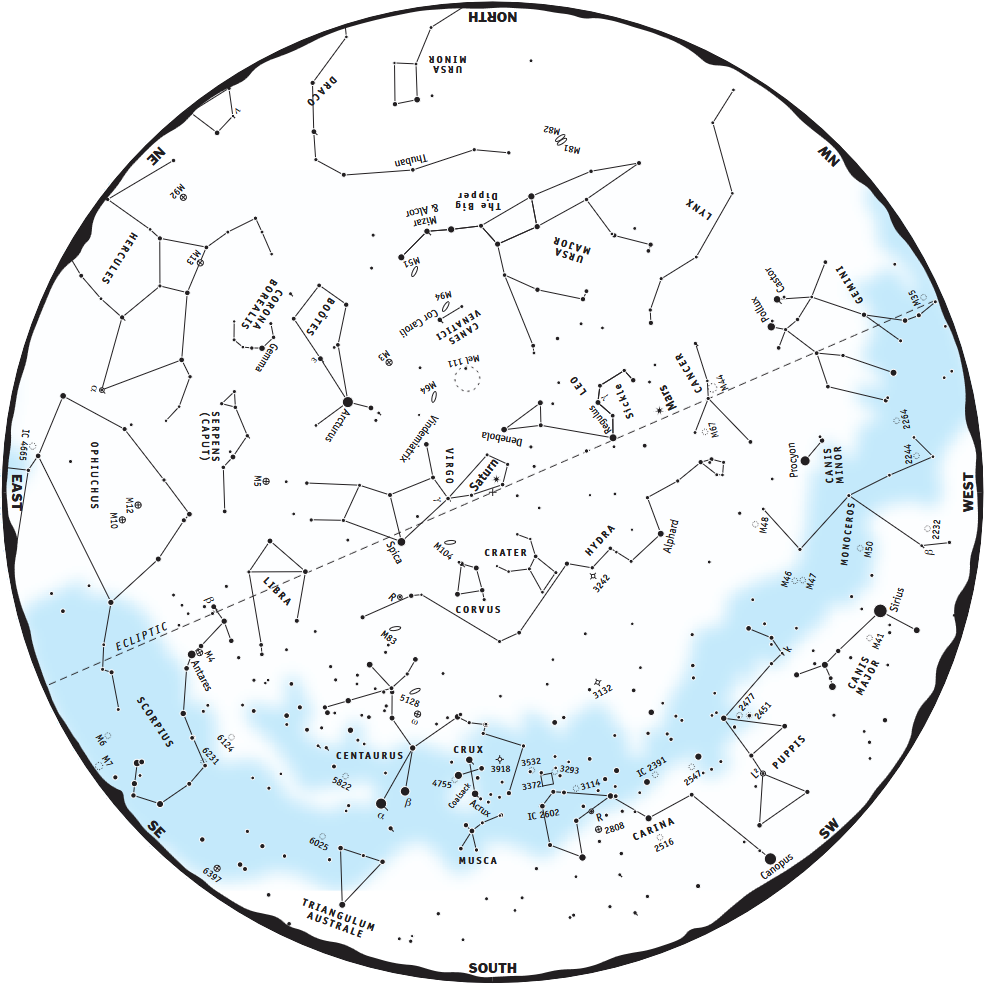
The map shows the sky over Malé on 15 May at 9 pm, but it also works on other dates, at a different time: the stars rise about 4 minutes earlier each evening, that is, 2 hours earlier each month.
| Date | Time when the map applies |
|---|---|
| 15 April | 11 pm |
| 1 May | 10 pm |
| 15 May | 9 pm |
| 1 June | 8 pm |
| 15 June | 7:30 pm (sky just dark) |
Times are Malé local time (UTC+5). Many resorts run on “island time”, one hour ahead: if yours does, add an hour.
As always, start from the sunset: facing the setting Sun you are looking west, so north is on your right, south on your left and east behind you. Hold the map above your head and turn it until its north matches the real north.
In this season there is also a purely starry way to find your bearings. At the time shown on the map, the Southern Cross stands exactly on the meridian, upright above the horizon: its long arm, extended downward, points to due south. On the opposite side, the two Pointer stars of the Big Dipper lead to the North Star, just 4 degrees above the sea. Seeing the North Star and the Southern Cross at the same time is a privilege of equatorial latitudes.
The northern sky
Ursa Major. At our latitudes the Big Dipper is circumpolar and never sets; here, instead, it is a seasonal constellation, and this is its moment. It lies low in the north, between 30 and 45 degrees above the horizon. The middle star of its handle, Mizar, has a faint companion, Alcor: the Arabs used the pair as an eyesight test. Through a telescope Mizar splits in two, and it was the first double star ever discovered with a telescope, in the 17th century. The system is about 83 light-years away.
Boötes and Arcturus. Follow the curve of the Dipper’s handle and you reach Arcturus, the orange star that dominates the north-eastern sky. Continue along the same curve and you reach Spica, in Virgo. English-speaking stargazers remember it with a rhyme: “arc to Arcturus, speed on to Spica”.
Arcturus is an orange giant 37 light-years away, about 25 times the diameter of the Sun. It is an old, fast-moving star just passing through the disk of the Galaxy: it will reach its closest point to the Sun in about 4,000 years, then move away again. In 1933 its light, collected by a telescope and turned into an electric current by a photocell, switched on the lights of the Chicago World’s Fair. The light was thought to have left the star in 1893, the year of the city’s previous World’s Fair.
Coma Berenices and Canes Venatici. Between Arcturus and Leo there is a veil of faint stars: Coma Berenices, Berenice’s Hair. It is a true open cluster (Melotte 111, about 280 light-years away), so close that it looks as wide as an outstretched hand. Legend has it that Queen Berenice offered her hair to the gods for the safe return of her husband, Ptolemy III, from war. When the lock vanished from the temple, the court astronomer Conon of Samos assured everyone that it had been placed among the stars. Higher up, in Canes Venatici, the Hunting Dogs, are the globular cluster M3 and the Whirlpool Galaxy, M51.
Leo. Early in the evening, Leo is sinking in the west. Here it sets head first: the mane and Regulus (79 light-years) go down into the sea first, while the tail with Denebola stays high above them. Regulus spins so fast that it is visibly flattened at the poles. In early April, just below Leo, you can still see the Beehive Cluster (M44), the last farewell of the winter sky.
Overhead
Virgo. The brightest star overhead is Spica, blue-white, about 250 light-years away. Its name means “ear of wheat”: Virgo was the goddess of the harvest, holding grain in her hand. Spica is actually a pair of extremely hot stars, so close that they orbit each other in just 4 days, both stretched into egg shapes by their mutual pull.
Between Virgo and Coma Berenices a window opens onto the deep sky: the Virgo Cluster, more than a thousand galaxies about 54 million light-years away. Its queen is M87, a giant elliptical galaxy. At its center lies a black hole of 6.5 billion solar masses, the first ever photographed: the Event Horizon Telescope image was released in 2019. Through a telescope M87 looks like a small round smudge, but knowing what it contains changes the way you see it.
A little farther south, on the border with Corvus, is the Sombrero Galaxy (M104), about 31 million light-years away. We see it edge-on, crossed by a band of dark dust like the brim of a hat.
Corvus, Crater and Hydra. Corvus, the Crow, is an easy-to-find quadrilateral of four stars, to the right of Spica. Next to it is Crater, the Cup, which is fainter, and below both winds Hydra, the Water Snake, the longest constellation in the sky: from its head, near Cancer, to its tail, below Libra, it stretches across a quarter of the horizon. Its main star, Alphard (about 180 light-years away), means “the solitary one”: there is nothing bright around it.
The three constellations tell a single story. Apollo sent the crow to fetch water with the cup, but the bird dawdled, waiting for some figs to ripen. To excuse himself, he came back carrying a water snake, claiming it had blocked the spring. Apollo was not fooled and placed all three in the sky: the crow remains forever one step away from the cup, unable to drink.
The southern sky
The Southern Cross. It is the smallest constellation in the sky, but just look south and you will recognize it at once: four bright stars about twenty degrees above the sea. In this season it reaches its highest point early in the evening.
The four stars are not alike. At the bottom is Acrux, blue-white, about 320 light-years away; through a telescope it splits in two. On the left is Mimosa, also blue, about 280 light-years away. At the top is Gacrux, the only orange one: a red giant just 88 light-years away, the closest of the four. A fifth, fainter star, Epsilon, sits out of place between the arms, and is nicknamed “the intruder”.
In antiquity the Cross was visible from the Mediterranean, before the precession of the Earth’s axis pushed it below the horizon; the Greeks considered it part of Centaurus. Dante recalls it in the first canto of the Purgatorio: “e vidi quattro stelle / non viste mai fuor ch’a la prima gente” (“and I saw four stars / never seen before but by the first people”). The first European to describe it accurately was a Florentine, Andrea Corsali, in a letter written in 1516 during a voyage across the Indian Ocean itself.
The Coalsack. Next to the Cross, to the left, the Milky Way is pierced by an oval black patch about ten full Moons wide. It is not an empty space but a cloud of dust about 600 light-years away that hides the stars behind it. For Aboriginal Australians it is the head of the Emu in the Sky, a great bird outlined by the dark clouds of the Milky Way.
Centaurus. To the left of the Cross shine two stars close together, Alpha and Beta Centauri, the “Pointers”: the line joining them leads straight to the Cross. Beta (Hadar) is a blue giant about 390 light-years away. Alpha Centauri is the nearest star system to the Sun: two stars similar to ours, 4.37 light-years away, orbiting each other every 80 years. The third member, the red dwarf Proxima Centauri, is slightly closer (4.24 light-years) and too faint to see with the naked eye. Since 2016 we have known that it has a planet orbiting in the zone where water could remain liquid.
Above the Pointers, about forty degrees up, is a fuzzy star that is not a star at all: Omega Centauri. It is the largest globular cluster in the Milky Way, with some ten million stars, about 17,000 light-years away. Ptolemy catalogued it as a star, which is why it bears a Greek letter. Today it is thought to be the core of a dwarf galaxy swallowed by our own. In 2024 the Hubble Space Telescope found stars at its center moving too fast to stay bound without a black hole of at least 8,000 solar masses: one of the strongest clues ever found to an “intermediate-mass” black hole.
Just above Omega is Centaurus A (NGC 5128), about 12 million light-years away. It is the result of a collision between two galaxies: through a telescope you can see a bright sphere cut across by a band of dark dust.
Carina. Toward the south-west the last winter treasures are setting: the Carina Nebula with Eta Carinae, and the Southern Pleiades cluster (IC 2602). Observe them early in the evening, before they set. Canopus and the Magellanic Clouds, on the other hand, are already below the horizon: they will return in the evenings at the end of the year.
Scorpius. In the south-east Scorpius is rising, with red Antares (about 550 light-years away), a supergiant 700 times larger than the Sun. Behind it, around midnight, Sagittarius rises with the center of the Galaxy: a preview of the July-September sky.
Recommended objects
The objects are grouped by instrument, and each one can also be seen with the more powerful instruments. For binoculars, an 8×40 or 10×50 is enough; for a telescope, any 7-10 cm travel scope will do.
With the naked eye
| Object | Constellation | Distance | What to look for |
|---|---|---|---|
| Arcturus | Boötes | 37 light-years | Its orange color, compared with Spica |
| Spica | Virgo | 250 light-years | Blue-white, almost overhead |
| Mizar and Alcor | Ursa Major | 83 light-years | The “eyesight test” pair |
| Southern Cross | Crux | 88-320 light-years | Orange Gacrux among three blue stars |
| Coalsack | Crux | 600 light-years | The black patch in the Milky Way |
| Alpha and Beta Centauri | Centaurus | 4.4 and 390 light-years | Two similar stars at very different distances |
| Omega Centauri | Centaurus | 17,000 light-years | A fuzzy “star” |
| Coma Berenices | Coma Berenices | 280 light-years | A veil of faint stars |
| Antares | Scorpius | 550 light-years | Its red color, compared with Mars if visible |
With binoculars
| Object | Constellation | Distance | What to look for |
|---|---|---|---|
| Omega Centauri | Centaurus | 17,000 light-years | A grainy ball of light, much larger than the Moon |
| Jewel Box (NGC 4755) | Crux | 6,400 light-years | Blue stars with a single red one in the middle |
| Southern Pleiades (IC 2602) | Carina | 490 light-years | A handful of bright blue stars |
| Carina Nebula (NGC 3372) | Carina | 7,500 light-years | Nebulosity cut by a dark lane |
| M3 | Canes Venatici | 34,000 light-years | A globular cluster, a small glowing ball |
| M5 | Serpens | 24,500 light-years | A globular cluster almost overhead |
| M83 | Hydra | 15 million light-years | A faint face-on spiral galaxy |
| Beehive Cluster (M44) | Cancer | 580 light-years | Only in early April, low in the west |
With a telescope
| Object | Constellation | Distance | What to look for |
|---|---|---|---|
| Omega Centauri | Centaurus | 17,000 light-years | Thousands of stars resolved right to the center |
| Centaurus A (NGC 5128) | Centaurus | 12 million light-years | The dark lane cutting across the galaxy |
| Sombrero (M104) | Virgo | 31 million light-years | The edge-on galaxy and its dust lane |
| M87 | Virgo | 54 million light-years | A round smudge: at its center is the black hole photographed in 2019 |
| Whirlpool (M51) | Canes Venatici | 31 million light-years | Two galaxies touching |
| Antennae (NGC 4038/4039) | Corvus | over 45 million light-years | Two colliding galaxies |
| Ghost of Jupiter (NGC 3242) | Hydra | — | A blue planetary nebula, the size of Jupiter |
| Acrux | Crux | 320 light-years | A double star, two blue points |
| Alpha Centauri A and B | Centaurus | 4.37 light-years | A yellow and orange double; in perspective they are drawing closer, and around 2037 they will be hard to split |
| Porrima (Gamma Virginis) | Virgo | 38 light-years | Twin stars, now splittable again |
Dates and tips
The Eta Aquariids (peak 5-6 May). This is the meteor shower of the season, and one of the few that can be seen better from the equator than from Europe. The meteors are debris left by Halley’s Comet, which the Earth crosses every year. The radiant, in Aquarius, rises around 2-3 am: in the two hours before dawn you can count as many as 30-40 meteors an hour, fast and often leaving a lingering trail. The same debris gives us the Orionids in October.
The Lyrids (22-23 April). A more modest shower, about ten meteors an hour after midnight, but the first of the year after months of quiet.
The zodiacal light. At the equator the ecliptic rises almost vertically from the horizon all year round. So, on moonless evenings, an hour after sunset you can see a milky blade of light rising from the sea in the west: it is sunlight scattered by dust in the solar system. Before dawn it appears in the same way in the east. Many people mistake it for the last glow of twilight.
The planets. We deliberately do not list them, because their positions change from year to year. Before you leave, check with Stellarium which ones will be visible during your stay.
Practical tips.
- Pick the right Moon: the weeks around New Moon are the best for the deep sky.
- Seek out the dark: the end of the jetty, or the beach on the side away from the bungalows, with the resort lights behind you.
- Use only red light, and give your eyes 20 minutes to adjust to the dark.
- Watch out for humidity: binoculars and telescopes brought out of an air-conditioned room fog up immediately. Leave them outside, in their case, for 30-60 minutes before use.
- A beach lounger is the best stargazing accessory: this season’s constellations are almost all high in the sky, and your neck will thank you.
- In May and June bring mosquito repellent: after the monsoon rains they are more active.
Back to Astronomy in the Maldives