
The sky of the galaxies
In autumn we look out beyond our own Galaxy. The Milky Way sinks toward the horizon, and overhead opens a sky with few bright stars but with the galaxies closest to us: Andromeda to the north, the two Magellanic Clouds to the south, and the Sculptor Galaxy high in the sky.
The weather also changes over the season. October and November are months of transition: the south-west monsoon (hulhangu) slowly fades, still bringing showers and thunderstorms. In December the north-east monsoon (iruvai) arrives: drier air, clear skies, calm seas. From December to April comes the best stargazing season of the year, which coincides with the tourist season.
A curiosity: this is the navigators’ sky. The constellations of the far south, such as the Phoenix, the Toucan, the Crane and the Peacock, have no Greek myths because the Greeks never saw them. They were drawn by Dutch navigators at the end of the 16th century, on voyages to the East Indies across this very ocean.
Finding your way
The map shows the sky over Malé on 15 November at 9 pm. As always, the stars run about 2 hours earlier each month, so the same map also works on other dates:
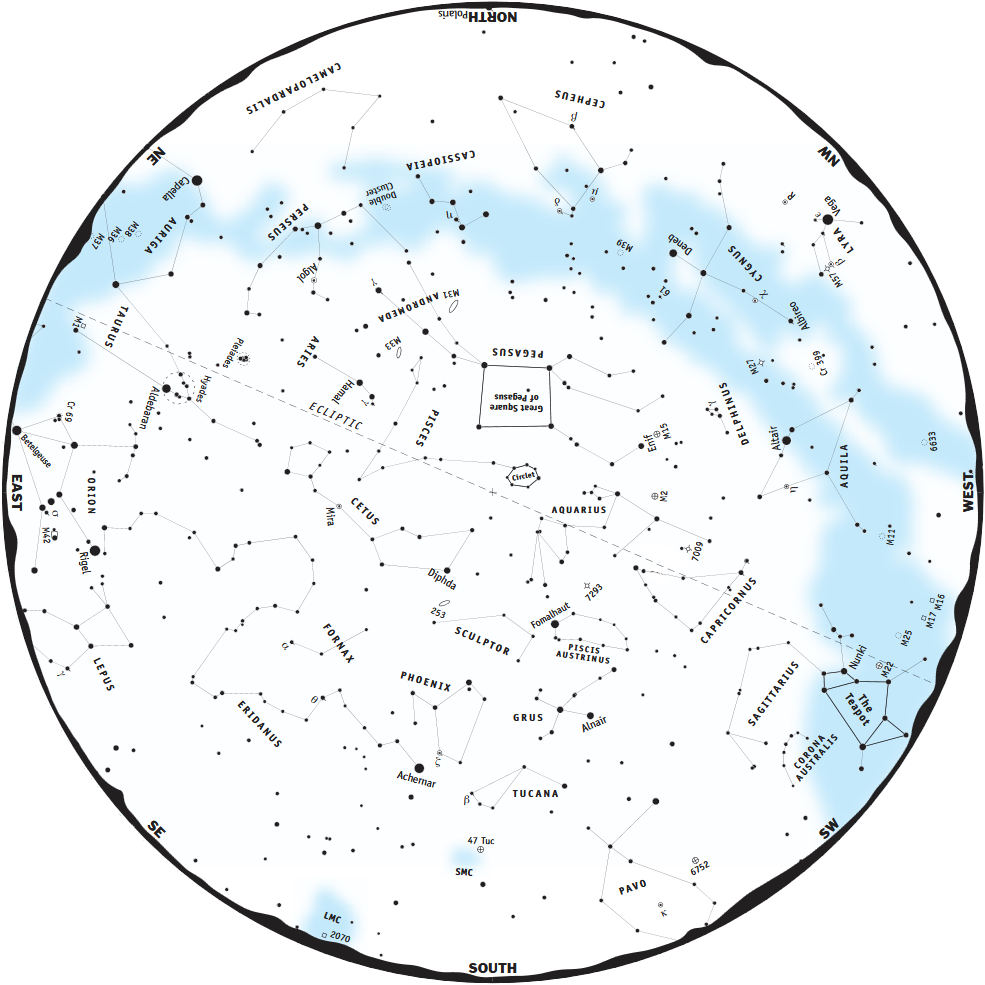
Courtesy of Skymaps.com
| Date | Time when the map applies |
|---|---|
| 15 October | 11 pm |
| 1 November | 10 pm |
| 15 November | 9 pm |
| 1 December | 8 pm |
| 15 December | 7:30 pm (sky just dark) |
Times are Malé local time (UTC+5); at resorts that run on “island time”, add an hour.
Start from the sunset: facing the setting Sun you are looking west, so north is on your right and south on your left. Hold the map above your head, with its north pointing to the real north.
In this season the key landmark is the Great Square of Pegasus, four moderately bright stars forming a large square almost overhead. The Square works as a signpost. Its western side, extended southward, leads to Fomalhaut, the bright, solitary star of Piscis Austrinus, the Southern Fish. Its eastern side leads to Diphda, in Cetus, the Whale. From its north-eastern corner starts the chain of stars of Andromeda, which in turn leads to Perseus.
[SKY MAP — to be added] To generate it with Stellarium: location Malé (4.17° N, 73.51° E), date 15 November, time 9 pm UTC+5; stereographic or fisheye projection centered on the zenith, with constellation lines and names, Milky Way on, stars down to magnitude 5, planets off.
The northern sky
The autumn sky stages a single myth, with the whole cast present. Queen Cassiopeia boasted that she was more beautiful than the sea nymphs. As punishment, Poseidon sent a sea monster, Cetus, to ravage the coasts of the kingdom. To appease it, King Cepheus had to chain his daughter Andromeda to a rock. She was rescued by Perseus, returning from slaying Medusa, riding the winged horse Pegasus. All six are in the sky on the same evening.
Cassiopeia and Cepheus. Low in the north, about 35 degrees up, Cassiopeia forms its characteristic W. Here it is a seasonal constellation, like the Big Dipper, which in these months is below the horizon. The North Star is barely visible, just 4 degrees above the sea. Farther left, toward the north-west, is the faint constellation of Cepheus: it contains a deep red star, Mu Cephei, which William Herschel called the “Garnet Star”.
Andromeda. From the north-eastern corner of the Square of Pegasus, a chain of stars runs toward Perseus: this is Andromeda. Count two stars along the chain, then move up a little toward the north, and a small elongated smudge appears: the Andromeda Galaxy (M31), 2.5 million light-years away. It is the most distant object easily visible without instruments. The light reaching us left it when the first members of the genus Homo were appearing on Earth.
Until 1923 no one knew whether that smudge was a nebula within the Milky Way or another galaxy. At Mount Wilson, Edwin Hubble found a variable star in M31 whose distance he could calculate: it was far beyond any star in our Galaxy. From that night on, the universe became immensely larger.
Andromeda and the Milky Way are approaching each other at more than 100 km per second. For decades a collision in about 4-5 billion years was taken for granted. Studies published in 2025, based on more precise data, put the chance instead at about 50% within the next 10 billion years.
Triangulum. Between Andromeda and Aries lies the small constellation of Triangulum, with another galaxy: M33, about 2.7 million light-years away. Under a perfect sky and with averted vision it can just be glimpsed with the naked eye, but it is a challenge.
Perseus. In the north-east, where the Milky Way rises from the sea, is Perseus. He holds the head of Medusa, whose eye is Algol, “the demon’s head” in Arabic. The name is no accident: every 2 days, 20 hours and 49 minutes Algol dims for about ten hours, dropping from magnitude 2.1 to 3.4, then returns to normal. It is a pair of stars that eclipse each other. This was explained in 1783 by John Goodricke, a young deaf astronomer who died at just 21.
Between Perseus and Cassiopeia lies the Double Cluster, two open clusters side by side about 7,500 light-years away, already visible to the naked eye as a faint haze.
The Summer Triangle sets. In the north-west, Vega, Deneb and Altair are going down, the last remnants of the summer sky. In October they are still high early in the evening; by December they are already setting at dusk.
Overhead
Pegasus. The Square is the body of the winged horse, which here flies upside down toward the west. Near its muzzle is M15, one of the densest globular clusters in the Galaxy, about 33,000 light-years away.
Cetus and Mira. The sea monster of the myth is a large, faint constellation east of the Square. Within it lies one of the strangest stars in the sky: Mira, “the wonderful”. It is a red giant that pulsates with a period of about 11 months. At its brightest it is easy to see, at magnitude 2-3; at its faintest it drops to magnitude 9-10 and vanishes from view. Depending on when you travel, you may find it shining brightly or not find it at all. It was the first variable star to be discovered, in 1596. In 2007 the GALEX satellite found that it trails a 13-light-year tail of gas behind it, like a comet.
Sculptor and the pole of the Galaxy. Between Cetus and Phoenix, high in the south, is Sculptor, a constellation with no bright stars. The reason is interesting: this is where the south galactic pole lies, the point in the sky perpendicular to the disk of the Milky Way. Looking in that direction, we pass through very few stars of our own Galaxy and see far out toward other galaxies. The most beautiful is NGC 253, the “Silver Coin”: a spiral seen almost edge-on, about 11 million light-years away, visible even in binoculars.
Piscis Austrinus and Fomalhaut. To the south-west, isolated in a region poor in stars, shines Fomalhaut, “the mouth of the fish”, 25 light-years away. Around it the Hubble Space Telescope had photographed a ring of dust and, inside it, what looked like a planet. In 2020 it became clear that the “planet” was an expanding cloud of debris, perhaps produced by the collision of two icy bodies. In 2023 the James Webb Space Telescope showed that there are at least three dust belts, one inside the other.
Aquarius and Capricornus. To the west, below Pegasus, are the faint constellations of Aquarius and Capricornus. In Aquarius lies the Helix Nebula (NGC 7293), about 650 light-years away: it is the nearest planetary nebula, almost half the size of the full Moon in the sky, but very faint.
Fornax. To the south-east, in the small constellation of Fornax, the Furnace, lies another cluster of galaxies, about 60 million light-years away. With a telescope you can see a dozen galaxies in the same field; the most beautiful is the barred spiral NGC 1365.
The southern sky
Eridanus and Achernar. The river Eridanus flows across the sky from Rigel, in Orion, all the way to the far south. From Italy we see only its beginning. Here we can see all of it, down to its mouth: Achernar, “the end of the river”, blue-white, about 140 light-years away, some thirty degrees above the sea toward the south. Achernar spins so fast that its diameter at the equator is about a third larger than at the poles: it is one of the most flattened stars known.
The southern birds. Between Fomalhaut and Achernar fly Phoenix, Grus (the Crane) and, lower down, Tucana (the Toucan). These are the constellations of the Dutch navigators Keyser and de Houtman, who measured the southern stars in 1595-97 during the first Dutch voyage to the Indies. The Crane is the most recognizable: a long line of stars with two bright ones, Alnair and Beta Gruis, the latter a lovely orange color.
The Small Magellanic Cloud. Low in the south, about a dozen degrees above the horizon, there is a little glowing cloud that does not move with the real clouds. It is the Small Magellanic Cloud, a satellite galaxy of our own, about 200,000 light-years away. You need a clear southern horizon free of haze, and that is exactly what an island beach offers.
Next to the Cloud is a smaller, more compact fuzzy ball: 47 Tucanae, the second finest globular cluster in the sky after Omega Centauri. They look close together, but that is a trick of perspective. 47 Tucanae belongs to our Galaxy and lies about 15,000 light-years away: the Cloud is thirteen times farther.
The Large Magellanic Cloud. In November it rises in the south-east only late in the evening; in December it is already up during the evening, always staying low. It is about 160,000 light-years away and contains the Tarantula Nebula, the largest star factory in the Local Group. In 1987 it hosted the nearest supernova seen in four centuries, visible to the naked eye from the southern hemisphere.
The Clouds are named after Magellan because they were described by Antonio Pigafetta, the man from Vicenza who chronicled his circumnavigation. But Europeans were not the first to see them. The Persian astronomer al-Sufi had already described the Large Cloud in 964, calling it “the White Ox”, visible from southern Arabia. And the Arab navigators of the Indian Ocean knew them well.
Winter is coming. In mid-December, between 7 and 8 pm, Orion and Sirius rise in the east, and Canopus, the second brightest star in the sky, rises in the south-east. It is the prelude to the January-March sky.
Recommended objects
The objects are grouped by instrument, and each one can also be seen with the more powerful instruments. For binoculars, an 8×40 or 10×50 is enough; for a telescope, any 7-10 cm travel scope will do.
With the naked eye
| Object | Constellation | Distance | What to look for |
|---|---|---|---|
| Andromeda Galaxy (M31) | Andromeda | 2.5 million light-years | A small elongated smudge, best with averted vision |
| Small Magellanic Cloud | Tucana | 200,000 light-years | A little cloud low in the south that never moves |
| 47 Tucanae | Tucana | 15,000 light-years | A fuzzy “star” next to the Cloud |
| Large Magellanic Cloud | Dorado | 160,000 light-years | December only, low in the south-east |
| Achernar | Eridanus | 140 light-years | The mouth of the celestial river |
| Fomalhaut | Piscis Austrinus | 25 light-years | The solitary star of the autumn sky |
| Algol | Perseus | 90 light-years | Compare it with nearby stars over a few nights |
| Mira | Cetus | 300 light-years | Is it there or not? It depends on its phase |
| Double Cluster | Perseus | 7,500 light-years | A faint haze in the Milky Way |
| Pleiades (M45) | Taurus | 440 light-years | Six or seven stars in the east, late in the evening |
With binoculars
| Object | Constellation | Distance | What to look for |
|---|---|---|---|
| Andromeda Galaxy (M31) | Andromeda | 2.5 million light-years | The bright core and its two satellite galaxies |
| Triangulum Galaxy (M33) | Triangulum | 2.7 million light-years | A faint glow, as large as the full Moon |
| Silver Coin (NGC 253) | Sculptor | 11 million light-years | A bright spindle, almost edge-on |
| Double Cluster (NGC 869/884) | Perseus | 7,500 light-years | Two clusters in the same field |
| 47 Tucanae | Tucana | 15,000 light-years | A very concentrated core |
| NGC 362 | Tucana | 28,000 light-years | A second, smaller globular cluster at the edge of the Cloud |
| M15 | Pegasus | 33,000 light-years | A compact globular near the horse’s muzzle |
| Helix Nebula (NGC 7293) | Aquarius | 650 light-years | A faint disk; needs a dark sky |
| Mu Cephei | Cepheus | — | The “Garnet Star”, the deepest red in the sky |
With a telescope
| Object | Constellation | Distance | What to look for |
|---|---|---|---|
| 47 Tucanae | Tucana | 15,000 light-years | Stars resolved right to the center |
| Silver Coin (NGC 253) | Sculptor | 11 million light-years | The dust patches along the disk |
| NGC 55 | Sculptor | 6.5 million light-years | An irregular, edge-on galaxy |
| NGC 1365 | Fornax | 60 million light-years | The central bar, with S-shaped arms |
| Saturn Nebula (NGC 7009) | Aquarius | — | A blue planetary nebula with two “handles” on its sides |
| Almach (Gamma Andromedae) | Andromeda | 350 light-years | An orange and blue double |
| NGC 346 | Tucana | 200,000 light-years | A region of newborn stars inside the Small Cloud |
| Tarantula Nebula (NGC 2070) | Dorado | 160,000 light-years | In December, late in the evening, inside the Large Cloud |
Dates and tips
The Geminids (peak 13-14 December). This is the richest meteor shower of the year, and a great reason to book in mid-December. The radiant, in Gemini, rises in the evening: from 10 pm until dawn you can see dozens of meteors an hour, slow and often colorful. Unusually, the Geminids come not from a comet but from an asteroid, 3200 Phaethon.
The Orionids (peak around 21 October). Like May’s Eta Aquariids, they are debris from Halley’s Comet. The radiant rises around midnight; before dawn you can count about twenty meteors an hour, very fast.
The Leonids (peak around 17 November). Today they produce few meteors, about ten an hour before dawn. But they are famous for the “storms” of the past, such as those of 1833 and 1966, when thousands of meteors an hour were counted.
The Taurids (October-November). Few meteors, but slow and sometimes very bright: it is worth keeping your eyes open even on ordinary evenings.
The zodiacal light. At the equator the ecliptic rises almost vertically all year round. On moonless evenings, an hour after sunset, you can see a milky blade of light rising from the sea in the west; before dawn it appears in the same way in the east. It is sunlight scattered by interplanetary dust.
The planets. We do not list them, because their positions change from year to year. Before you leave, check with Stellarium which ones will be visible during your stay.
Practical tips.
- Pick the right Moon: the weeks around New Moon are the best for galaxies and the Magellanic Clouds.
- For the Magellanic Clouds you need a clear southern horizon: look for a south-facing beach or the end of the jetty.
- Use only red light, and give your eyes 20 minutes to adjust to the dark.
- Watch out for humidity: binoculars and telescopes brought out of an air-conditioned room fog up immediately. Leave them outside, in their case, for 30-60 minutes before use.
- In October and November the monsoon clouds pass quickly: if the sky is overcast, try again an hour later.
Back to Astronomy in the Maldives