
For centuries, Maldivians divided the year into 27 periods of 13–14 days, the nakaiy. Each period is named after a group of stars and has a character of its own: winds, rains, the state of the sea, the fish that arrive. Fishermen used it to decide when to head out to sea, farmers when to sow, navigators when to set sail for Ceylon or India.
The name itself reveals where it comes from: nakaiy is the Dhivehi form of the Sanskrit nakṣatra, the 27 “lunar mansions” of Indian astronomy. The same system survives in Kerala, 500–700 km across the sea from the atolls, as a farming calendar (njattuvela). It is a piece of ancient astronomy that is still alive, and anyone watching the sky in the Maldives can read it right overhead.
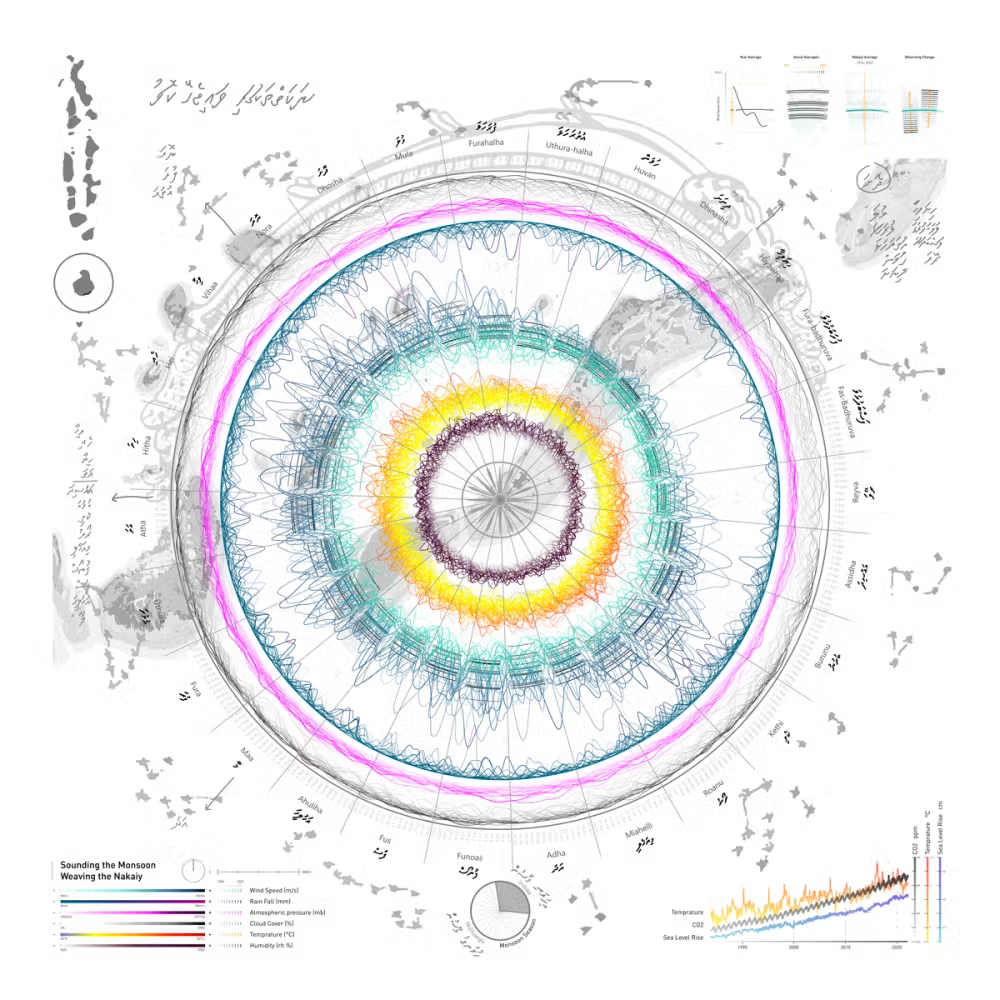
Illustration from the Weaving the Nakaiy project
How it works: the Sun among the stars
Along the ecliptic, the path the Sun follows through the constellations over a year, Indian astronomy fixed 27 groups of stars, one every 13°20′. Originally they marked the path of the Moon, which crosses one each day. The Sun, instead, takes about thirteen and a half days for each. That is exactly what a nakaiy is: the period during which the Sun “dwells” in one of those mansions.
This leads to a paradox. The stars that give their name to the current nakaiy are the only ones you cannot see: they are behind the Sun, drowned in its glare. During Kethi (6–19 May), named after the Pleiades, the Pleiades are invisible. To see them you have to wait until November, when they pass high overhead at midnight.
It is often said that each nakaiy is named after the star that rises at sunset, but the opposite is true: the star rising at sunset belongs to the mansion opposite the Sun. For stargazers there is a simple rule. At midnight, high in the sky, you will find the stars of the nakaiy that comes six months later, about 13–14 periods further down the table.
In ancient times, the change from one period to the next could be checked by the heliacal rising: the first morning on which a star becomes visible again in the east, just before dawn, after weeks hidden by the Sun. Today the dates are fixed in our calendar and shift by a single day at most, depending on leap years and on the source.
The Maldivian dates run about a week ahead of those in Kerala. The Indian solar year begins on 14 April, when the Sun enters Ashvini, whereas the corresponding nakaiy, Assidha, begins on 8 April. Among Maldivian historians, however, 14 April remains a special date: it is Bihuroazu, the “seventh day of Assidha”, which marks the end of iruvai (the dry monsoon season).
The two seasons: iruvai and hulhangu
The 27 nakaiy fall into the two monsoon seasons, which rule everything in the Maldives: the sea, fishing, travel.
- Iruvai, the north-east monsoon, runs from December to April, from Mula to Reyva. It brings dry air, clear skies and calm seas: it is the season for sea voyages and deep-sea fishing, and also the best for stargazing. The name points to the east, where the Sun rises (iru in Dhivehi).
- Hulhangu, the south-west monsoon, runs from May to October, from Kethi to Hey. It brings rain, squalls and rough seas. In the worst periods, such as Roanu, Miyahelia and Funoas, fishermen stayed close to their island, mending boats and nets.
Between the two seasons there are periods of transition. In April, Assidha and Burunu often open with a storm; in November, Viha, Nora and Dosha have light, variable winds. Sources disagree on where to place them. According to historian and astronomer Abdulla Rasheed, hulhangu runs from 6 May, the start of Kethi, to 31 October, the end of Hey; other calendars start hulhangu as early as Assidha, on 8 April.
The Maldives Meteorological Service puts the onset of the south-west monsoon at around 8 May: just a few days from the traditional date.
The 27 nakaiy
The dates are the traditional ones, and may differ by a day from one source to another. The nakshatras are given by their Sanskrit names, the stars by their Western names. The weather is what tradition expects, not a forecast.
| # | Nakaiy | Dates | Nakshatra | Stars | Traditional weather |
|---|---|---|---|---|---|
| 1 | Mula | 10–22 Dec | Mūla | Tail of Scorpius (Shaula, Lesath) | Strong wind, rough sea |
| 2 | Furahalha | 23 Dec–5 Jan | Pūrvāṣāḍhā | Sagittarius (Kaus Australis, Kaus Media) | Strong north-easterly winds, rough sea |
| 3 | Uthurahalha | 6–18 Jan | Uttarāṣāḍhā | Sagittarius (Nunki, Ascella) | Blue sky, strong wind |
| 4 | Huvan | 19–31 Jan | Śravaṇa | Altair (Aquila) | Calm sea, blue sky |
| 5 | Dhinasha | 1–13 Feb | Dhaniṣṭhā | Delphinus | North-easterly winds, plenty of sunshine |
| 6 | Hiyaviha | 14–26 Feb | Śatabhiṣā | Aquarius (Lambda Aquarii) | Calm sea, hot days and nights |
| 7 | Furabadhuruva | 27 Feb–11 Mar | Pūrva Bhādrapadā | Pegasus (Markab, Scheat) | Short thunderstorms with lightning |
| 8 | Fusbadhuruva | 12–25 Mar | Uttara Bhādrapadā | Pegasus and Andromeda (Algenib, Alpheratz) | Usually clear |
| 9 | Reyva | 26 Mar–7 Apr | Revatī | Pisces (Zeta Piscium) | Storms rare but intense |
| 10 | Assidha | 8–21 Apr | Aśvinī | Aries (Sheratan, Mesarthim) | Opens with a storm, then hot and dry |
| 11 | Burunu | 22 Apr–5 May | Bharaṇī | Aries (41 Arietis) | Storm at first, then calm |
| 12 | Kethi | 6–19 May | Kṛttikā | Pleiades | Dark clouds, frequent rain |
| 13 | Roanu | 20 May–2 Jun | Rohiṇī | Aldebaran and the Hyades (Taurus) | Storms, strong wind, rough sea |
| 14 | Miyahelia | 3–16 Jun | Mṛgaśīrṣa | Head of Orion (Meissa) | Storms, strong westerly winds |
| 15 | Adha | 17–30 Jun | Ārdrā | Betelgeuse (Orion) | South-westerly winds, light rain |
| 16 | Funoas | 1–14 Jul | Punarvasu | Castor and Pollux (Gemini) | Storms and sudden squalls |
| 17 | Fus | 15–28 Jul | Puṣya | Cancer (Asellus Australis) | Rainy and cloudy |
| 18 | Ahuliha | 29 Jul–10 Aug | Āśleṣā | Head of Hydra | Storms less frequent |
| 19 | Maa | 11–23 Aug | Maghā | Regulus (Leo) | Generally calm |
| 20 | Fura | 24 Aug–6 Sep | Pūrva Phalgunī | Leo (Zosma) | Scattered showers, north-westerly winds |
| 21 | Uthura | 7–20 Sep | Uttara Phalgunī | Denebola (Leo) | Strong north-westerly winds |
| 22 | Atha | 21 Sep–3 Oct | Hasta | Corvus | Clear and calm, scattered showers |
| 23 | Hitha | 4–17 Oct | Citrā | Spica (Virgo) | Light winds, scattered showers |
| 24 | Hey | 18–31 Oct | Svātī | Arcturus (Boötes) | Strong winds from all directions; excellent tuna fishing |
| 25 | Viha | 1–13 Nov | Viśākhā | Libra (Zubenelgenubi, Zubeneschamali) | Calm sea, good fishing |
| 26 | Nora | 14–26 Nov | Anurādhā | Head of Scorpius (Dschubba, Acrab) | Light winds, showers, unsettled currents |
| 27 | Dosha | 27 Nov–9 Dec | Jyeṣṭhā | Antares (Scorpius) | Light north-easterly winds |
Almost all the star groups lie in the constellations of the zodiac, with a few exceptions: Altair, Delphinus, the Square of Pegasus and Arcturus lie well north of the ecliptic. They were probably chosen because they are bright and easy to recognise, in stretches of the zodiac that are poor in stars.
To use the table under the night sky, remember the rule: the stars of the current nakaiy are behind the Sun; at midnight you will see those about 13–14 rows further down (or further up).
Today’s nakaiy in the Maldives
The traditional calendar in 27 periods · tap a segment to explore it
Today
- Expected weather
- Stars
- Nakshatra
- Next
Origins, traditional use and today
We do not know when the nakaiy reached the Maldives. The names clearly come from Indian astronomy, through Dhivehi, a sister language of Sinhala. The system probably arrived with Buddhist culture and with trade between the atolls, Ceylon and the Malabar coast, long before the conversion to Islam in 1153. Some even trace its origins back to the Indus Valley civilisation, but there is no evidence for this.
What is certain is that the Maldivians did not simply copy it. Each nakaiy was linked to a type of weather, a state of the sea, the arrival of a particular fish: an archive of observations refined over centuries of fishing trips. Hey, in late October, is famous for its large tuna; Roanu and Miyahelia, from late May into June, for their gales. This knowledge was passed on by word of mouth, from the captains of fishing boats (dhoni) to their apprentices, and from elders to the young.
The religious calendar of the Maldives is a different one: the Islamic lunar calendar, which sets the dates of Ramadan and the festivals. The nakaiy instead follow the Sun, and therefore the seasons, which is why they remain useful at sea and in the fields.
Today GPS and satellite forecasts have taken their place, but the nakaiy have not disappeared. Fishermen, farmers and elders still refer to them to explain a sudden storm or a change of wind; there are smartphone apps, such as Nakaiy Nevi, that show the nakaiy of the day; and the Maldives’ National Centre for Cultural Heritage has included texts on the nakaiy in its documentation of intangible cultural heritage. And as the climate changes, researchers are beginning to use them as a historical archive: comparing today’s weather with the weather the nakaiy “expect” is one way of measuring how far the seasons are shifting.
Live weather
If you want to check the weather in the Maldives live, we suggest these four superb webcams, spread along the whole length of the country. Comparing them is most interesting at the turn of the seasons. As the Maldives Meteorological Service explains, the south-west monsoon reaches the south first and then moves up through the centre to the north. Between late April and May, Kooddoo may be under rain while the sky over Hanimaadhoo is still clear.
- Hanimaadhoo – The Barefoot Eco Hotel & Villas beach (Haa Dhaalu Atoll, in the north). Useful for comparing the sky between the north and the south of the country, which can be very different depending on the monsoon.
- Kuredu Island Resort (Lhaviyani Atoll, north-centre). The best-known and longest-running webcam in the Maldives: a long beach and lagoon. There is also a second one on the sandbank.
- Sunset Beach, Veligandu (Rasdhoo Atoll, central Maldives). As the name suggests, it looks out over the sunset beach. If it really faces west, with a little luck it is the right one for watching the sunset live.
- Mercure Kooddoo (Gaafu Alif Atoll, in the south). The webcam looks out over the Kooddoo lagoon and is the reference point for the south: set beside Hanimaadhoo, it shows live how the sky changes from one end of the country to the other. There is also a second webcam at the same resort.